
Control-plane API
Everything the operator console can do to a store, the API can do too — create it, read its usage, move its plan, attach a domain, toggle its apps. Pair it with webhooks so an integration also hears about changes it did not make itself.
- Base URL:
https://<central-domain>/api/platform/v1 - API version:
2026-09-02, sent asX-Tenancy-Api-Versionon every response and asapi_versioninside every webhook payload.
Overview
Central-domain only. The API sits behind the same CentralDomainsOnly guard as the console. A request to a store's own subdomain or custom domain 404s — there is no per-store copy of this API.
Operator-scoped. A key is a platform credential, not a store credential: every key can see and change every store. This is not a tenant-facing API, and it is not gated by the api_access plan feature in config/general.php — that flag is reserved for a future storefront-facing API and has no effect on /api/platform/v1.
Not the storefront API. Botble's own vendor/botble/api (products, carts, customers) is a separate, tenant-scoped surface with its own middleware stack. This API never runs inside Laravel's api middleware group, because that group carries Botble's shared-key middleware.
Versioning. X-Tenancy-Api-Version is bumped only for a breaking change to a response or payload shape. Additive fields are not a bump — decode leniently.
Enabling the API
The API is enabled by default — TENANCY_API_ENABLED defaults to true, so a fresh install answers /api/platform/v1 as soon as a key exists. There is no opt-in step; the variable exists to switch the API off:
TENANCY_API_ENABLED=falseWhile it is off, every request (any verb, OPTIONS included, known path or not) answers 503 api_disabled before any key is looked at, so a disabled API cannot be used as an oracle for which keys are valid:
{"error":{"code":"api_disabled","message":"The control-plane API is disabled on this platform."}}Keys stay manageable in the console while the API is off, so you can prepare an integration before switching it on.
Authentication
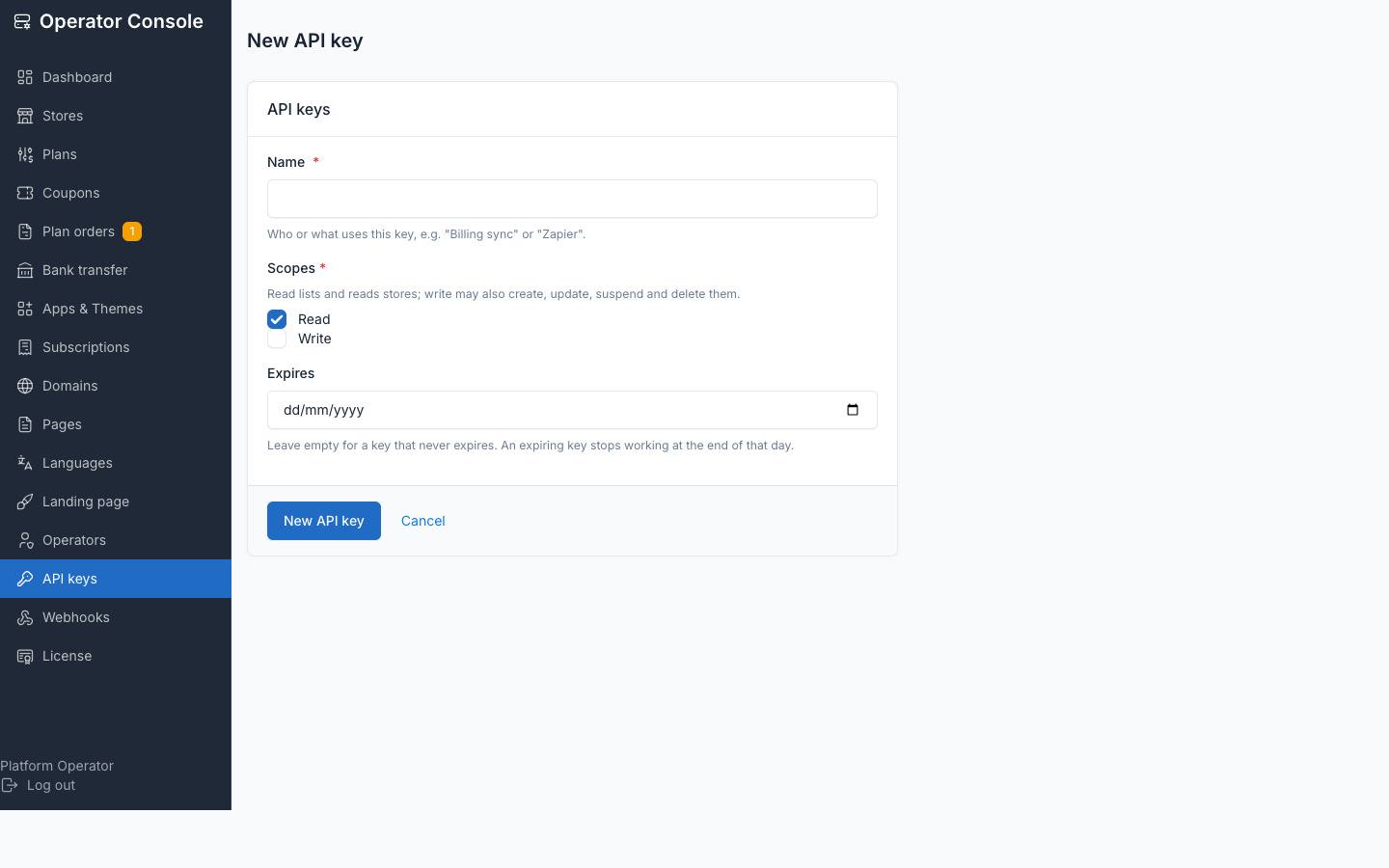
Issue a key in the console: Operator console → API keys → New key. Pick scopes and (recommended) an expiry date.
WARNING
The plaintext key is shown once, on the page that creates it. It is stored only as a sha256 hash — a lost key cannot be recovered, only revoked and reissued.
Send it as a bearer token (preferred) or in X-API-Key:
curl -s https://platform.example.com/api/platform/v1/me \
  -H 'Authorization: Bearer tnk_xxxxxxxx_xxxxxxxxxxxxxxxxxxxxxxxxxxxxxxxxxxxxxxxx'

curl -s https://platform.example.com/api/platform/v1/me \
  -H 'X-API-Key: tnk_xxxxxxxx_xxxxxxxxxxxxxxxxxxxxxxxxxxxxxxxxxxxxxxxx'
Scopes
| Scope | Grants |
|---|---|
read | GET / HEAD / OPTIONS on every endpoint |
write | every other verb — create, edit, suspend, cancel, delete |
Scope is derived from the HTTP method, never declared per route, so a mutating endpoint added later cannot become reachable with a read-only key by omission.
WARNING
A write key can delete stores and their databases. Treat it as a root credential: issue read-only keys unless writes are genuinely needed, always set an expiry, and revoke immediately on suspicion. Deletion is irreversible.
Revocation and expiry take effect on the next request. Every write a key makes is attributed to it in the store's audit log (actor.type = "api_key").
Rate limiting
Two buckets, both per minute:
| Bucket | Key | Env | Default |
|---|---|---|---|
| Per credential | sha256 of the presented token | TENANCY_API_RATE_LIMIT | 120 |
| Per client IP | the caller's IP, across every token it presents | TENANCY_API_RATE_LIMIT_PER_IP | 600 |
The per-IP ceiling stops one host opening a fresh per-token bucket for every guessed key; set it to 0 to disable it. Keep it well above the per-key limit so several legitimate keys behind one NAT are not throttled together.
Throttling runs before the key lookup, so an invalid or revoked key burns the caller's budget rather than the database. A 429 carries Retry-After and the X-RateLimit-* headers.
Errors
Every failure — including the throttler's 429 and a 404 for an unknown path — uses one envelope:
{"error":{"code":"subdomain_taken","message":"That address is already in use."}}A 422 adds field messages:
{
  "error": {
    "code": "validation_failed",
    "message": "The subdomain field is required.",
    "errors": {"subdomain": ["The subdomain field is required."]}
  }
}
code is the stable contract; message is localised and may change. Branch on the code.
A known path with the wrong verb answers 405 method_not_allowed with an Allow header listing the verbs it accepts. OPTIONS is not special-cased — it goes through the same host check, kill switch and authentication as every other request.
| Code | Status | Meaning |
|---|---|---|
api_disabled | 503 | TENANCY_API_ENABLED=false |
unauthenticated | 401 | No bearer token and no X-API-Key header |
invalid_key | 401 | Token does not match any key |
key_revoked | 401 | The key was revoked in the console |
key_expired | 401 | The key is past expires_at |
insufficient_scope | 403 | The key lacks read / write for this method |
forbidden | 403 | The action is not permitted |
not_found | 404 | Unknown path, or the store / domain / endpoint does not exist |
method_not_allowed | 405 | The path exists but not for this verb; see the Allow header |
rate_limited | 429 | Either bucket is empty; honour Retry-After |
validation_failed | 422 | Request body or query failed validation |
plan_too_small | 422 | The target plan's limits are below the store's current usage |
http_error | (varies) | Any other HTTP exception the platform raised; the status is the exception's own |
server_error | 500 | Unexpected failure; the message is generic unless APP_DEBUG |
Conflicts (409)
A 409 means the request was well formed but refused by the platform's own rules — the same refusal the console shows an operator.
| Code | Raised when |
|---|---|
subdomain_reserved | The requested subdomain is on the reserved list |
subdomain_taken | The subdomain (or its fallback host) is already in use |
not_provisioned | The store is still pending / provisioning, so it cannot be suspended, resumed or given a plan |
no_subscription | The store has no subscription row for this action |
no_tenant | The subscription's store no longer exists |
plan_unavailable | The plan behind the action was retired or deleted before it could be applied |
confirm_mismatch | confirm on DELETE /stores/{id} did not equal the store id |
still_provisioning | Deletion refused while provisioning is still running |
plan_upgrade_required | The plan does not allow custom domains |
limit_reached | The plan's custom-domain limit is already used up |
already_taken | That hostname is registered to another store |
verify_first | A domain must be DNS-verified before it can be primary |
not_removable | The fallback (platform) domain cannot be removed |
not_entitled | The plan does not include that app |
requirement_not_entitled | An app the target app depends on is not in the plan |
still_required | Another enabled app depends on the one being disabled |
theme_not_entitled | The plan does not include that theme |
theme_requirement_not_entitled | A plugin the theme requires is not in the plan |
theme_unavailable | The theme is not installed, published, or its assets are missing |
stripe_managed | The subscription is driven by Stripe; change it in Stripe |
illegal_transition | The action is not legal from the subscription's current status |
same_plan | The store is already on that plan |
no_plan | The subscription has no plan to act on |
store_unavailable | The store has no database yet (apps cannot be read or changed, the theme cannot be switched) |
usage_unavailable | ?refresh=1 could not collect live usage |
delivery_not_retryable | The delivery is not in a state a manual retry may force |
Three more 409 codes exist for the bank-transfer flow and today are raised only by the console (no v1 endpoint reaches them), but they share the envelope and are reserved: offline_disabled, order_already_open, order_not_pending.
Pagination
List endpoints accept per_page (default 30, max 100) and page, and answer with a meta block:
{
  "data": [ ],
  "meta": {"page": 1, "per_page": 30, "total": 412, "last_page": 14}
}
There is no links.next / links.prev; walk pages until page === last_page. Non-paginated collections (/plans, /stores/{id}/domains, /stores/{id}/apps) return the whole set, with meta carrying resource-specific context instead of page counters.
Endpoints
All examples assume:
export API=https://platform.example.com/api/platform/v1
export KEY='tnk_xxxxxxxx_xxxxxxxxxxxxxxxxxxxxxxxxxxxxxxxxxxxxxxxx'
alias capi='curl -s -H "Authorization: Bearer $KEY" -H "Accept: application/json"'
Platform
GET /platform · scope read — the constants a client needs before anything else.
capi $API/platform{
"data": {
"api_version": "2026-09-02",
"grace_days": 14,
"retention_days": 30,
"central_domain": "platform.example.com",
"features": {"custom_domain": {"label": "Custom domain", "description": "Connect your own domain",
"default": false, "column": "allows_custom_domain"}},
"webhook_events": ["store.created", "store.ready", "..."]
}
}GET /me · scope read — the calling key, to confirm which credential and scopes are in use.
{
  "data": {
    "id": 3, "name": "Billing sync", "key_prefix": "tnk_a1b2c3d4",
    "scopes": ["read", "write"], "is_usable": true,
    "created_by_name": "Ada", "last_used_at": "2026-09-02T10:15:00+00:00",
    "expires_at": "2027-01-01T00:00:00+00:00", "revoked_at": null,
    "created_at": "2026-08-01T09:00:00+00:00"
  }
}
Plans
| Method + path | Scope | Notes |
|---|---|---|
GET /plans | read | ?include_inactive=1 to include retired plans a store may still be grandfathered on |
GET /plans/{slug} | read |
capi $API/plans{
"data": [{
"id": 2, "slug": "pro", "name": "Pro", "description": "For growing shops",
"price_cents": 4900, "currency": "USD", "interval": "month", "trial_days": 14,
"limits": {"products": 5000, "orders": 0, "storage_mb": 20480, "staff_users": 10},
"features": {"custom_domain": true},
"allows_custom_domain": true, "is_active": true, "sort_order": 2
}]
}A limit of 0 means unlimited. stripe_price_id is never exposed.
Stores
GET /stores · scope read — ?status=, ?q= (name / subdomain / owner email), ?include=usage, ?per_page=.
capi "$API/stores?status=ready&per_page=2&include=usage"{
"data": [{
"id": "acme", "name": "Acme Supply", "status": "ready",
"access_state": "serving", "theme": "amerce", "preset": "fashion",
"owner_email": "owner@acme.test", "root_url": "https://acme.example.com",
"provisioned_at": "2026-07-04T12:00:03+00:00",
"created_at": "2026-07-04T12:00:00+00:00",
"updated_at": "2026-09-01T08:12:44+00:00",
"billing_provider": "local",
"usage": {"period": "2026-09", "products": 128, "orders": 41,
"storage_bytes": 730920141, "staff_users": 3,
"collected_at": "2026-09-02T03:00:00+00:00"}
}],
"meta": {"page": 1, "per_page": 2, "total": 37, "last_page": 19}
}access_state answers "what does a visitor get right now?" and mirrors the storefront gate exactly: serving, preparing (still provisioning), suspended (billing), or unavailable. billing_provider is stripe, local (operator/offline-managed) or none.
POST /stores · scope write → 202 Accepted. The row exists; provisioning is queued and the store reaches ready (and fires store.ready) once a worker has built its database.
capi -X POST $API/stores -H 'Content-Type: application/json' -d '{
  "subdomain": "acme",
  "name": "Acme Supply",
  "owner_email": "owner@acme.test",
  "password": "correct horse battery staple",
  "theme": "amerce",
  "preset": "fashion",
  "plan": "pro",
  "trial_days": 14
}'| Field | Rule |
|---|---|
subdomain | required, ^[a-z0-9][a-z0-9-]*$, ≤63 chars, not reserved, not taken |
name | required, ≤120 |
owner_email | required, email, ≤190 |
password | required, ≥8 — the store admin's password |
theme | optional; the catalog default when omitted, otherwise must be installed |
preset | optional; must be a preset of that theme |
plan | optional plan slug (active plans only); omit for an unbilled store |
trial_days | optional, 0..365 |
{
  "data": {"id": "acme", "status": "pending", "access_state": "preparing"},
  "links": {"self": "https://platform.example.com/api/platform/v1/stores/acme"}
}
GET /stores/{id} · scope read — the store plus its cached usage block and its subscription (or null).
PATCH /stores/{id} · scope write — partial update of name, owner_email, theme.
capi -X PATCH $API/stores/acme -H 'Content-Type: application/json' \
  -d '{"name": "Acme Supply Co", "theme": "shopwise"}'
The theme switch runs before name / owner_email are persisted: it is the only part that can refuse, and it refuses before writing anything, so a 409 (theme_unavailable, theme_not_entitled, …) leaves the store completely unchanged rather than half-edited. A successful call emits store.theme_changed and store.updated.
DELETE /stores/{id} · scope write → 204. Irreversible: the store's database and storage are dropped. confirm must be a string equal to the store id.
capi -X DELETE $API/stores/acme -H 'Content-Type: application/json' -d '{"confirm": "acme"}'422 validation_failed when confirm is missing or not a string (a number, an array); 409 confirm_mismatch when the string does not match; 409 still_provisioning while provisioning is in flight.
POST /stores/{id}/suspend · /resume · /cancel — scope write.
Suspend takes the storefront offline immediately. Suspend and resume both require a provisioned store: 409 not_provisioned while it is still pending / provisioning (a store that fails provisioning is handled by store.provisioning_failed, not by suspension). Cancel needs a subscription (409 no_subscription) and returns both resources:
{"data": {"store": {}, "subscription": {"status": "cancelled"}}}GET /stores/{id}/usage · scope read — the cached central snapshot (refreshed by tenancy:collect-usage).
?refresh=1 opens the store's own database for a live count. It is opt-in because it costs a connection per call, and it answers 409 usage_unavailable rather than a 500 when the count cannot be trusted: the store has never been provisioned (provisioned_at is null), or the connection or query fails.
capi "$API/stores/acme/usage?refresh=1"{
"data": {
"store_id": "acme", "period": "2026-09", "live": true,
"usage": {"period": "2026-09", "products": 128, "orders": 41,
"storage_bytes": 730920141, "staff_users": 3,
"collected_at": "2026-09-02T11:04:19+00:00"}
}
}GET /stores/{id}/events · scope read — the store's billing/lifecycle audit trail, newest first, paginated.
{
  "data": [{
    "id": 918, "type": "plan_changed", "from_status": "active", "to_status": "active",
    "data": {"plan": "pro", "from_plan": "starter", "manual": true},
    "actor": {"type": "api_key", "id": 3, "name": "Billing sync"},
    "created_at": "2026-09-01T08:12:44+00:00"
  }],
  "meta": {"page": 1, "per_page": 30, "total": 12, "last_page": 1}
}
data is an allow-listed subset of the stored audit blob (plan, from_plan, trial_days, manual, extended_days, field, until, from, to, reason, order, number). Provider references — anything stripe* — are never exposed here or in a webhook's meta.log.
Subscription
GET /stores/{id}/subscription · scope read — 404 no_subscription when the store has none.
capi $API/stores/acme/subscription{
"data": {
"status": "active",
"plan": {"id": 2, "slug": "pro", "name": "Pro", "price_cents": 4900,
"currency": "USD", "interval": "month", "trial_days": 14,
"limits": {"products": 5000, "orders": 0, "storage_mb": 20480, "staff_users": 10},
"features": {"custom_domain": true}, "allows_custom_domain": true,
"taken_at": "2026-07-04T12:00:00+00:00"},
"coupon_code": null,
"trial_ends_at": null,
"current_period_ends_at": "2026-10-04T12:00:00+00:00",
"past_due_since": null, "suspended_at": null, "cancelled_at": null,
"created_at": "2026-07-04T12:00:00+00:00",
"updated_at": "2026-09-01T08:12:44+00:00",
"allowed_actions": ["change_plan", "extend", "cancel"]
}
}plan is the frozen snapshot the store actually bought, not the live plan row — that is what makes grandfathering work. Compare it against GET /plans/{slug} to see whether the live terms have moved on.
allowed_actions is a list of action names legal from the current state, not a map of action → reason. It is advisory: the authoritative answer is the 409 from the action itself. fulfil_order is never listed — order review stamps an admin identity an API caller does not have.
| Method + path | Body | Scope | Notes |
|---|---|---|---|
POST /stores/{id}/subscription/assign | {"plan":"pro","trial_days":14} | write | trial_days optional |
POST /stores/{id}/subscription/change-plan | {"plan":"starter"} | write | 422 plan_too_small when the store exceeds the target's limits; 409 same_plan |
POST /stores/{id}/subscription/extend | {"days":30} | write | 1..3650 |
POST /stores/{id}/subscription/reactivate | — | write | after a cancel, within retention |
POST /stores/{id}/subscription/cancel | — | write | store enters retention, then is purged |
All five answer the subscription resource. A Stripe-managed subscription refuses every one with 409 stripe_managed — change it in Stripe.
Domains
{domain} is either the row id or the hostname.
GET /stores/{id}/domains · scope read
{
  "data": [
    {"id": 11, "domain": "acme.example.com", "tenant_id": "acme", "is_primary": false,
     "is_fallback": true, "is_custom": false, "verified_at": null, "is_routable": true,
     "created_at": "2026-07-04T12:00:00+00:00"},
    {"id": 12, "domain": "shop.acme.test", "tenant_id": "acme", "is_primary": true,
     "is_fallback": false, "is_custom": true,
     "verified_at": "2026-07-05T09:30:00+00:00", "is_routable": true,
     "created_at": "2026-07-05T09:00:00+00:00"}
  ],
  "meta": {"plan_allows_custom_domains": true, "max_custom_domains": 3}
}
POST /stores/{id}/domains · scope write — {"domain":"shop.acme.test"} → 201, with a verification block (txt_name, txt_value, cname_target) carrying the exact DNS records to publish — present only while the domain is custom and still unverified. Refusals: 409 plan_upgrade_required, 409 limit_reached, 409 already_taken.
POST /stores/{id}/domains/{domain}/verify · scope write — runs a DNS check now.
{"data": {"id": 12, "verified_at": "2026-07-05T09:30:00+00:00", "is_routable": true},
 "verification_result": {"verified": true, "method": "txt", "reason": null}}
POST /stores/{id}/domains/{domain}/primary · scope write — 409 verify_first for an unverified domain (an unverified primary would poison every generated URL).
DELETE /stores/{id}/domains/{domain} · scope write → 204; 409 not_removable for the platform fallback host.
Apps and theme
Both run inside the store's own context, so a store with no database yet answers 409 store_unavailable.
GET /stores/{id}/apps · scope read
{"data": [{"slug": "ecommerce", "name": "Ecommerce", "enabled": true, "required_by": []},
          {"slug": "marketplace", "name": "Marketplace", "enabled": false, "required_by": ["ecommerce"]}]}
POST /stores/{id}/apps/{slug}/enable · /disable · scope write — answer the full list again. Refusals: 409 not_entitled, 409 requirement_not_entitled, 409 still_required.
POST /stores/{id}/theme · scope write — {"theme":"shopwise"} — answers the store resource and emits store.theme_changed. Refusals: 409 store_unavailable for a store that has not been provisioned yet, 409 theme_unavailable, 409 theme_not_entitled, 409 theme_requirement_not_entitled.
Webhook endpoints
GET /webhooks · scope read (paginated) · GET /webhooks/{id} · scope read
{
  "data": [{
    "id": 4, "url": "https://hooks.acme.test/tenancy",
    "events": ["store.*", "subscription.plan_changed"],
    "description": "Ops bot", "is_active": true, "is_receiving": true,
    "consecutive_failures": 0, "disabled_at": null,
    "last_success_at": "2026-09-02T10:59:01+00:00", "last_failure_at": null,
    "created_by_name": "Billing sync",
    "created_at": "2026-08-10T11:00:00+00:00", "updated_at": "2026-09-02T10:59:01+00:00"
  }],
  "meta": {"page": 1, "per_page": 30, "total": 1, "last_page": 1}
}
POST /webhooks · scope write → 201.
capi -X POST $API/webhooks -H 'Content-Type: application/json' -d '{
  "url": "https://hooks.acme.test/tenancy",
  "events": ["store.*", "subscription.plan_changed"],
  "description": "Ops bot"
}'{"data": {"id": 4, "url": "https://hooks.acme.test/tenancy"},
"secret": "whsec_xxxxxxxxxxxxxxxxxxxxxxxxxxxxxxxxxxxxxxxx"}WARNING
This response is the only time the signing secret is readable (besides a rotation) — store it immediately.
url must be HTTPS, and the platform refuses its own network: any central domain or label under one, any registered store domain, localhost, and loopback / private / link-local / reserved addresses (422 validation_failed). See Webhooks → adding an endpoint for the full host check and event-name syntax.
PATCH /webhooks/{id} · scope write — partial update of url, events, description, is_active. Setting is_active to true also clears an auto-disable (disabled_at and the failure counter), so re-enabling is one call.
DELETE /webhooks/{id} · scope write → 204. Its deliveries cascade away with it.
POST /webhooks/{id}/rotate-secret · scope write — the old secret stops validating immediately; there is no grace window, so update the receiver in the same maintenance window.
{"data": {"id": 4, "secret": "whsec_xxxxxxxxxxxxxxxxxxxxxxxxxxxxxxxxxxxxxxxx"}}POST /webhooks/{id}/test · scope write → 202. Sends a ping to this endpoint regardless of its subscriptions and of its state — an inactive or auto-disabled endpoint is still contacted, because checking a repaired receiver before re-enabling it is exactly what a test is for. The first attempt is made inline, so the returned delivery row already carries the receiver's answer (status, response_status, response_excerpt, error) — a test that says delivered really was delivered.
Deliveries
GET /webhooks/{id}/deliveries · scope read — ?status=, ?event=, ?include=payload, paginated, newest first. Payloads are opt-in: a page of them would repeat a full store snapshot per row.
{
  "data": [{
    "id": 9021, "endpoint_id": 4,
    "event_id": "01K4A6QF8Z5T7M1N0J2W3D4E5F", "event": "store.ready",
    "tenant_id": "acme", "attempt": 2, "status": "delivered",
    "response_status": 200, "response_excerpt": "ok", "error": null,
    "next_attempt_at": null, "delivered_at": "2026-09-02T10:59:01+00:00",
    "created_at": "2026-09-02T10:53:44+00:00", "updated_at": "2026-09-02T10:59:01+00:00"
  }],
  "meta": {"page": 1, "per_page": 30, "total": 214, "last_page": 8}
}
See Webhooks → delivery status for what each status and error value means.
POST /webhooks/deliveries/{id}/retry · scope write — forces one attempt inline (the caller waits for the receiver's answer) and returns the row with its payload included.
An attempt reserves the row by bumping attempt, flipping status to pending and leasing next_attempt_at into the near future. So a row that is pending with attempt > 0 and a next_attempt_at in the future is being sent right now, and a retry of it answers 409 delivery_not_retryable rather than sending the event twice. Once the lease lapses (a worker killed mid-request), the same row becomes retryable again — by this endpoint and by the cron sweep.
Issuing and revoking a key from the console
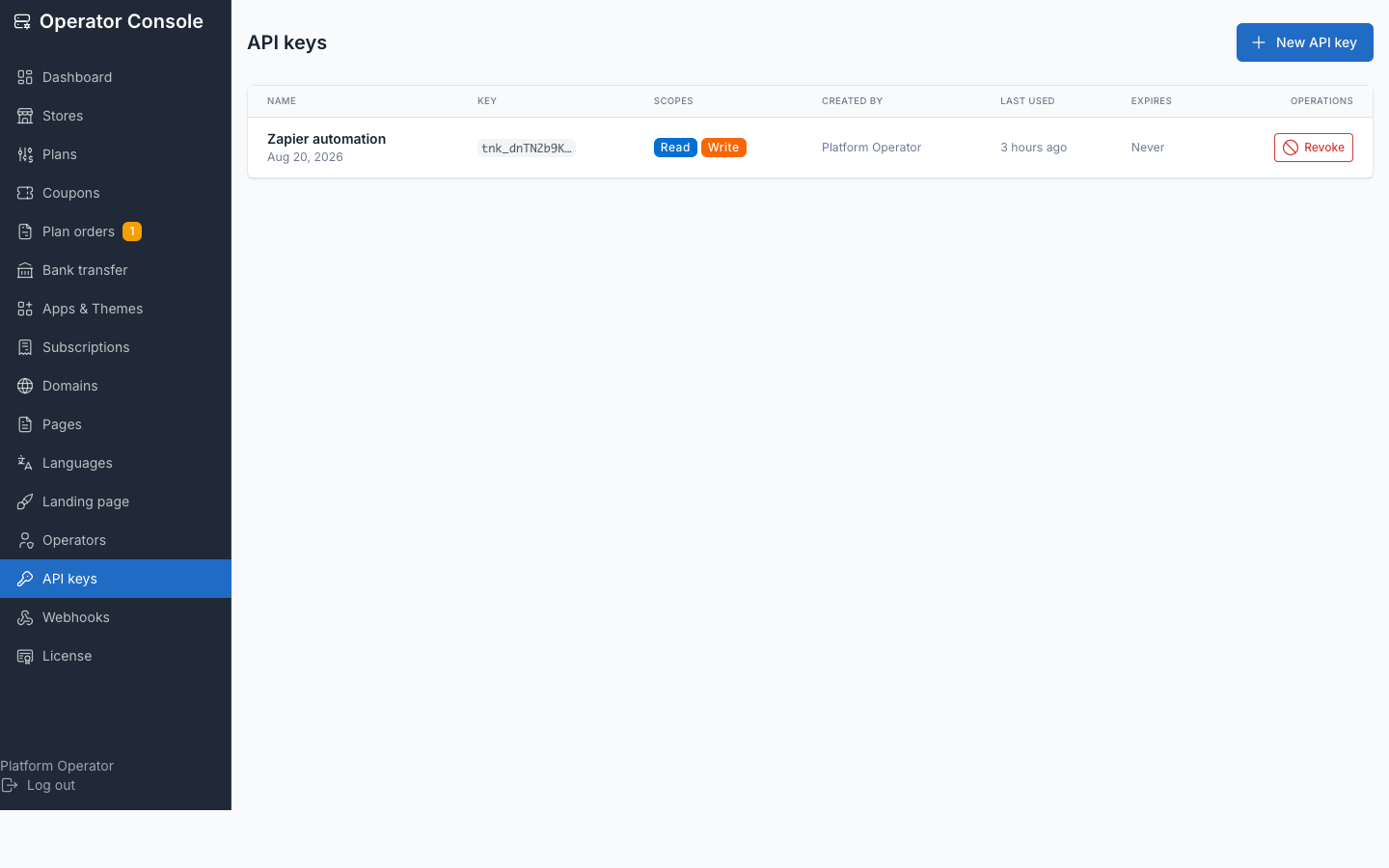
Operator console → API keys → New key. Set:
| Field | Notes |
|---|---|
| Name | Label for the key, shown in the list and in audit-log entries |
| Scopes | read, write, or both |
| Expiry | Recommended for every key |
WARNING
The plaintext key is shown once, on the page that creates it. It is stored only as a sha256 hash — a lost key cannot be recovered, only revoked and reissued.
Click Revoke on the list to disable a key immediately — it takes effect on the next request. Every write a key makes is attributed to it in the store's audit trail (actor.type = "api_key"), so the History panel on Operator console → Subscriptions → a subscription shows which integration did what.
Operational notes
APP_KEYrotation invalidates every webhook secret. Secrets are stored with Laravel'sencryptedcast, so after rotating the key each endpoint's secret can no longer be decrypted and every delivery fails. Rotate the secret of every endpoint (POST /webhooks/{id}/rotate-secret) and update the receivers immediately after anyAPP_KEYrotation. API keys are unaffected — they are sha256 hashes, not encrypted.- Deleting an endpoint deletes its deliveries. The history cascades at the database; export it first if you need it.
store.deletedpayloads outlive the tenant. Delivery rows carry no foreign key totenants, so the snapshot of a deleted store is still delivered (and retried) after the row and its database are gone.- Emitting never breaks the action. Every emit is wrapped so a broken endpoints table or an unreachable receiver can never roll back the store change it was describing. If an event never arrives, the change still happened — reconcile through the REST API.
tenancy:create-tenanthonoursprovisioning.sync. Without--syncthe command takes the same path as signup and the API: queued unlessTENANCY_PROVISION_SYNC=true(or the queue driver issync), in which case it provisions inline.- Order of operations for a new integration: issue a
readkey → confirm withGET /me→ register an endpoint and store its secret →POST /webhooks/{id}/testand verify the signature on theping→ subscribe to real events → add thetenancy:webhooks-delivercron entry (see Webhooks and Queue worker and cron).
See Webhooks for the event catalogue, payload shape and signature verification, and Operator console for the rest of the console.