
How it works
Ecommerce SaaS is one codebase, one control plane, and a separate database per customer store. The rest of the tree is stock Botble plus whichever themes you install, so upgrades stay manageable. The entire tenancy layer lives in one self-contained package: platform/packages/tenancy (Botble\Tenancy\).
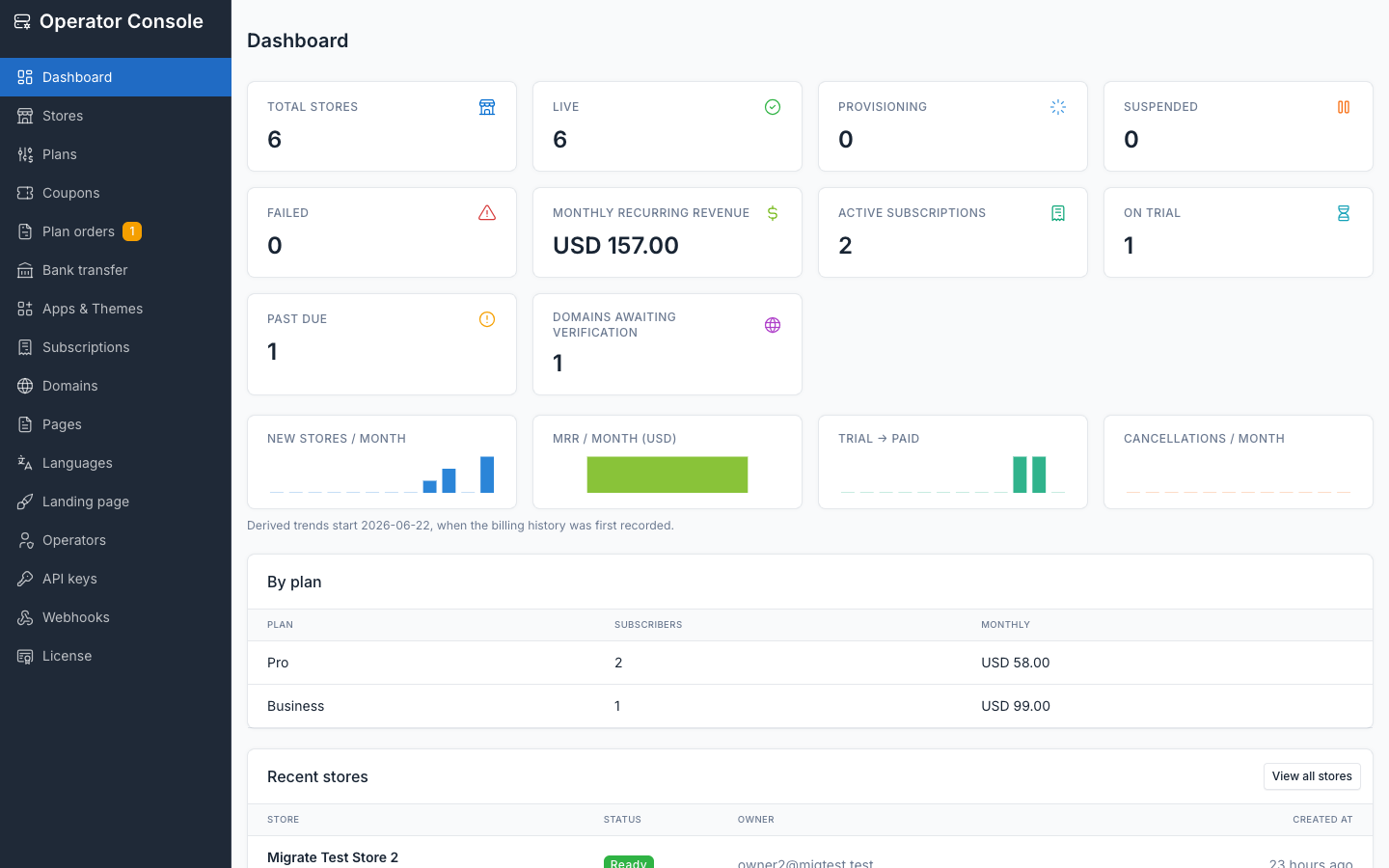
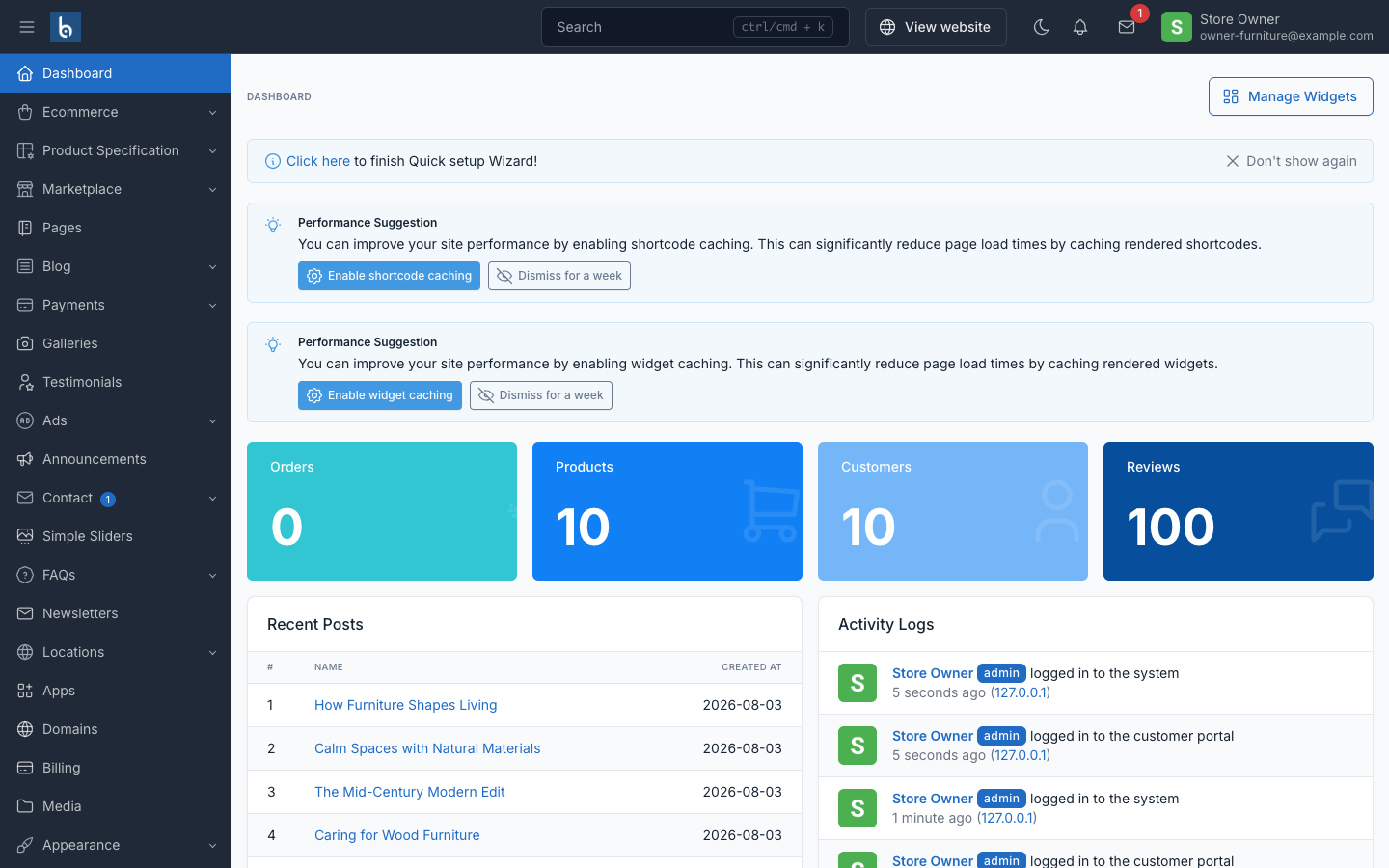
Central vs tenant context
Every request runs in one of two contexts:
- Central — the control-plane domain (
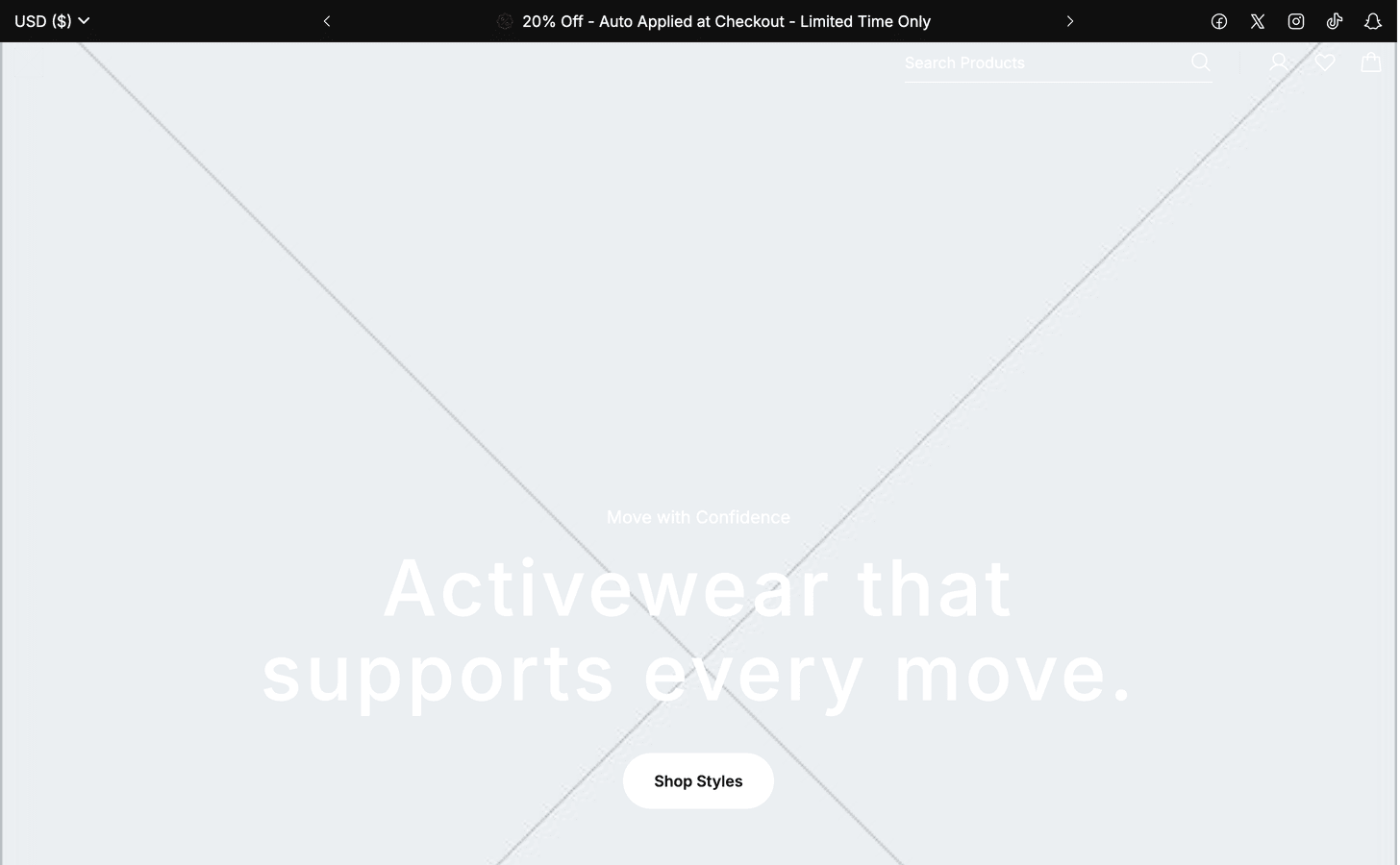
CENTRAL_DOMAINS). This is the platform owner's side: the landing page, self-serve signup, and the operator console at/admin/operator(its ownadminsguard, not Botble users). - Tenant — a store's own subdomain or custom domain. This is the store owner's side: their storefront and their store admin at
/admin(ordinary Botble, running against that store's own database).
Database-per-tenant
Built on stancl/tenancy v3: one central database holds the control plane (operators, the tenant registry, plans, subscriptions, usage, billing), and each store gets its own MySQL database, named <TENANCY_DB_PREFIX><id>.
What is re-bootstrapped on a tenant switch
When tenancy initializes for a request, a chain of bootstrappers runs, in order: the database connection is swapped to the tenant's own database, then cache, filesystem and queue are re-scoped, and Botble's own cached identity is forgotten so it rebuilds against the tenant connection.
That last step matters because Botble resolves "who am I" during provider boot — before any tenancy middleware runs — and caches it in singletons and static properties: settings (SettingStore), the active theme, the mail configuration, and the list of activated plugins. Under PHP-FPM each request is a fresh process, so the blast radius is limited to whatever resolved before tenancy initialized — but a queue worker handling jobs for several tenants in the same process would otherwise leak settings, mail config and plugin state between stores. Forgetting those cached instances forces them to rebuild lazily against the correct tenant, which is what keeps stores isolated from each other in long-lived processes.
Two restricted admin surfaces
Both admins are Botble super-users under the hood, so hiding menu items alone is cosmetic — the real boundary is at the route layer:
| Surface | Menu-hiding provider | What it hides |
|---|---|---|
| Central (operator) | RestrictCentralAdminServiceProvider | Every storefront content plugin (Ecommerce, Products, Pages, Blog, Galleries, Payments, …) — the platform owner runs no storefront on the central domain, so this leaves a focused panel: Dashboard, Stores, Users/Roles, Settings, System. |
| Tenant (store owner) | RestrictTenantAdminServiceProvider | Platform-owner tooling and any catalog app the store isn't running — the store owner gets the full Botble storefront admin minus what could break the platform. |
Each provider re-checks tenancy()->initialized before it fires, so the removal is a no-op on the wrong side — the central provider never touches a tenant admin, and the tenant provider never touches the operator console.
Request-time entitlement gating
Plugin service providers register during app boot, from the central database, before any tenancy middleware has identified the tenant. That means every catalog app has its routes registered on every request, whatever a given store actually has turned on — so "off" has to be enforced after the tenant is known, at request time, not at boot:
(plan allowlist UNION grants) MINUS revokes MINUS denylist
  INTERSECT active catalog rows INTERSECT what is actually on disk
BlockDisabledPluginRoutes 404s the routes of any app a store isn't entitled to — this is the actual enforcement, permission-independent (store owners are super-users, so ACL permissions can't restrict them), and 404 rather than 403 so an owner gets no signal a screen exists behind an upgrade. Because everything expensive already happened at provisioning (every plugin's tables are migrated into every store's database up front), turning an app on or off is a single settings write with no migration, no asset publishing and no effect on any other store.
What is not supported
- Laravel Octane. Botble caches identity in statics that are per-request under FPM but cross-tenant under Octane.
- Per-store plugin sets. Plugins are activated platform-wide; the plugin manifest is one file for the whole install, and the Plugins screen is hidden from store admins by design.
php artisan config:cacheunless you verify tenant switching afterwards — cached config pins the central database credentials.
Related
- Requirements and Installation
- Apps and themes — the catalog and entitlement model from the operator's side
- Control-plane API and Webhooks