
Webhooks
Outbound webhooks tell an integration about a change it did not make itself — a store finished provisioning, a subscription went past due, a domain verified. Pair them with the control-plane API so an integration can both act on the platform and hear about changes made elsewhere (the console, Stripe, a signup).
Adding an endpoint
Operator console → Webhooks → New endpoint.
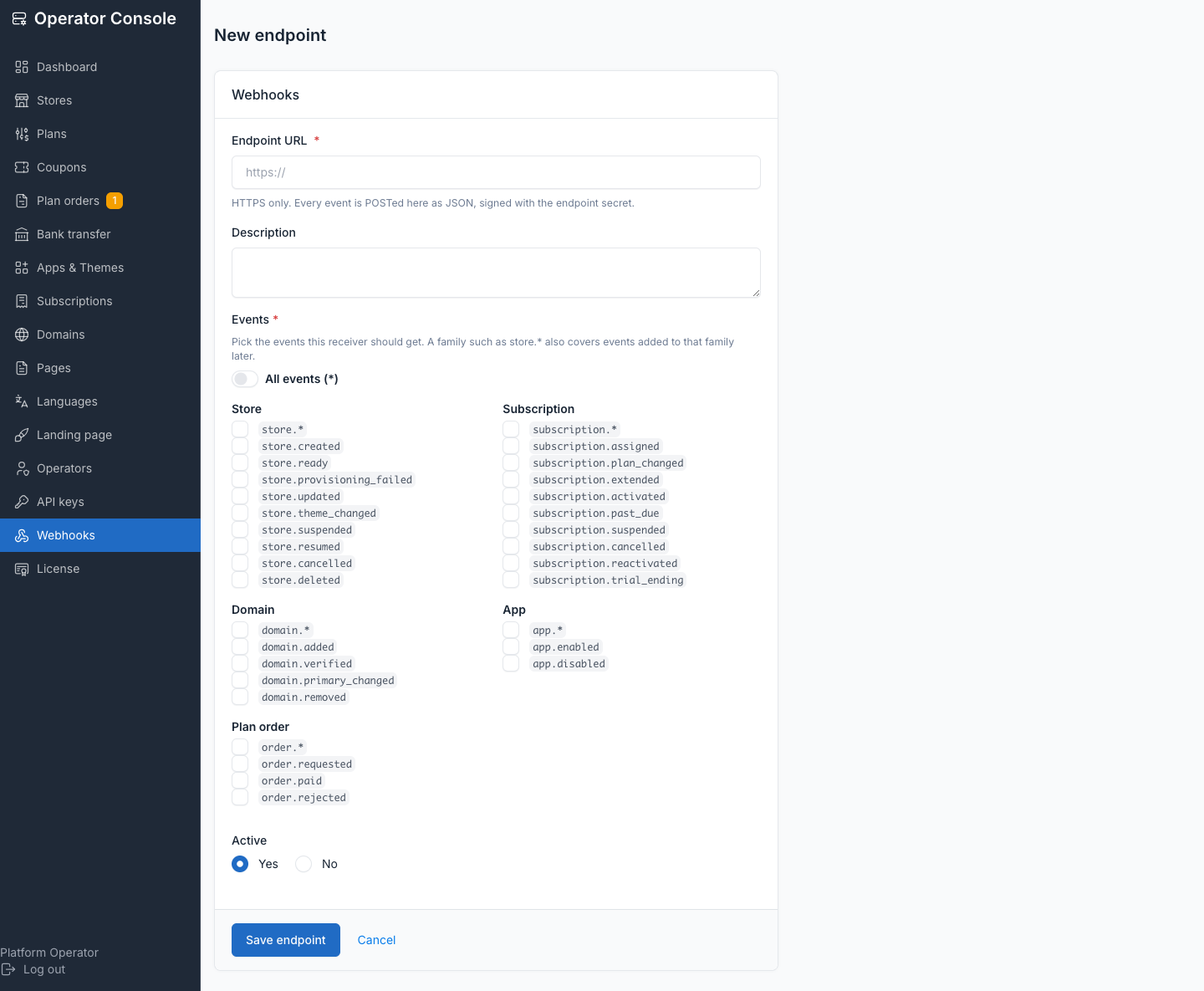
| Field | Notes |
|---|---|
| URL | Must be HTTPS |
| Events | Exact event names, a resource wildcard (store.*, subscription.*, domain.*, app.*, order.*), or * for everything including events added later |
| Description | Free text, shown in the endpoint list |
The URL must not point at the platform's own network: a central domain or any label under one, a registered store domain, localhost, or a private / loopback / link-local / reserved address are all refused (422 validation_failed). The hostname is resolved — at creation and again before every send — so a name that merely points at a private address is refused too, and a DNS record re-pointed inward after creation is caught at send time: that delivery fails with error: unsafe_host (no request is made) and retries on the normal schedule. Redirects are never followed at delivery time.
TENANCY_WEBHOOKS_ALLOW_PRIVATE_HOSTS=trueLifts the address check for a local receiver during development — never set it in production.
WARNING
The signing secret is shown once, at creation (and again on a rotation). It is not stored anywhere you can read back later.
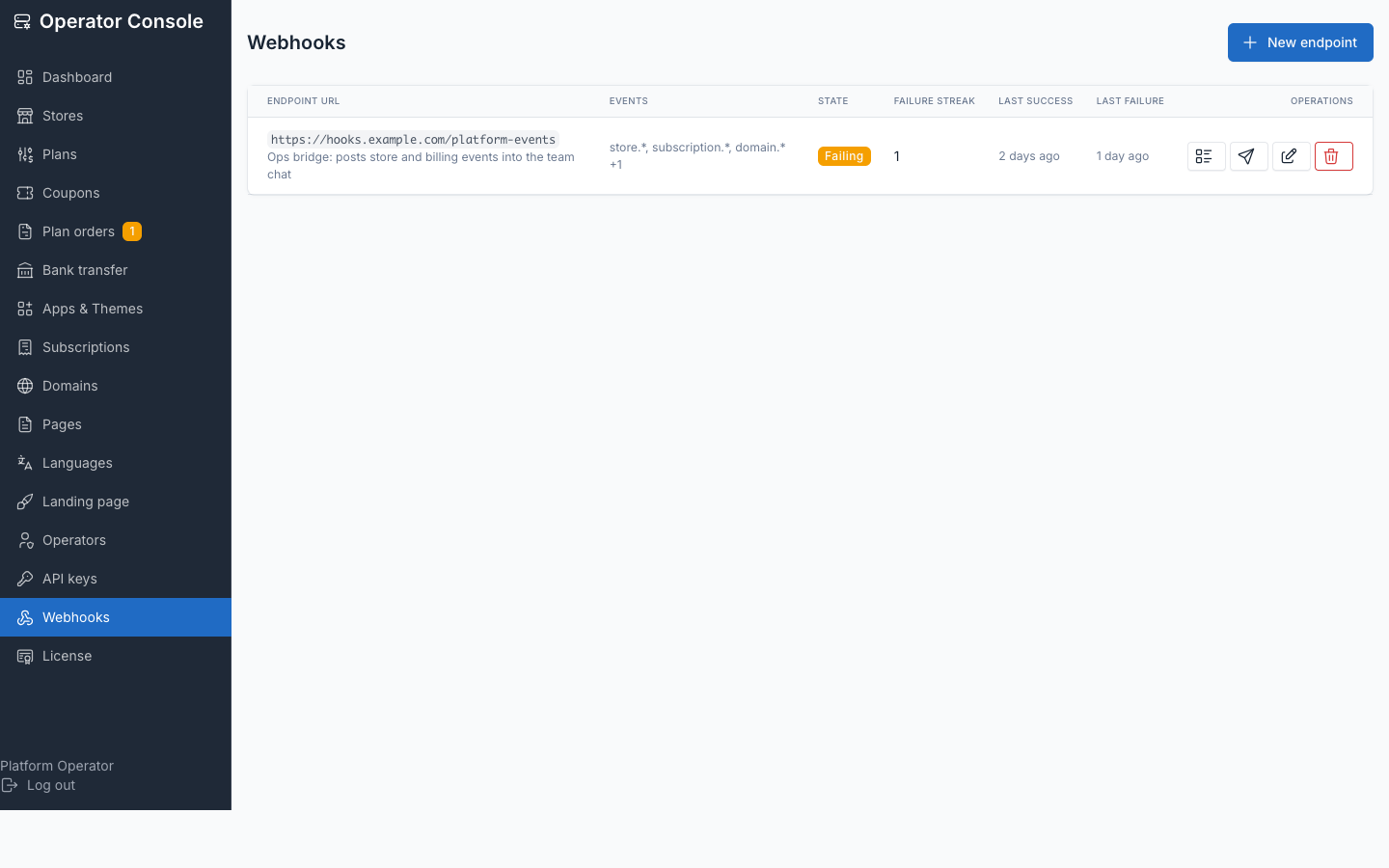
Event catalogue
27 subscribable events, plus ping (deliverable only via the test button / POST /webhooks/{id}/test, never subscribable).
| Event | Fired when | data beyond store |
|---|---|---|
store.created | The row exists; provisioning has not run yet. Fires before the plan is assigned, so it never carries subscription — subscription.assigned follows as the next event | — (meta.source) |
store.ready | Provisioning finished; the storefront is live | provisioning{preset,theme,apps,plugin_migration_paths} |
store.provisioning_failed | Provisioning threw | error{message,class} |
store.updated | name / owner_email changed | changes{field:{from,to}} |
store.theme_changed | The storefront theme was switched | theme{from,to} |
store.suspended | The store was taken offline | subscription?, meta.log |
store.resumed | The store was brought back online | subscription?, meta.log |
store.cancelled | The subscription was cancelled; retention starts | subscription, retention_days |
store.deleted | The store and its database were dropped | subscription?, meta.reason |
subscription.assigned | A plan was attached to a store with none | subscription, meta.log |
subscription.plan_changed | Upgrade or downgrade | subscription, meta.log |
subscription.extended | The period was extended manually | subscription, meta.log |
subscription.activated | Became active (trial converted, payment cleared) | subscription, meta.log |
subscription.past_due | A payment failed; the grace period started | subscription, meta.log |
subscription.suspended | The grace period ran out | subscription, meta.log |
subscription.cancelled | Cancelled | subscription, meta.log |
subscription.reactivated | Revived within retention | subscription, meta.log |
subscription.trial_ending | A trial reminder email went out | subscription, trial{ends_at,days_left} |
domain.added | A custom domain was attached | domain |
domain.verified | DNS verification passed (first time only) | domain |
domain.primary_changed | The primary domain moved | domain, previous_primary? |
domain.removed | A domain was detached | domain |
app.enabled | A store turned an app on | app{slug} |
app.disabled | A store turned an app off | app{slug} |
order.requested | A bank-transfer order was raised | order{} |
order.paid | An offline order was approved | order{}, subscription |
order.rejected | An offline order was rejected | order{} |
ping | The test button / POST /webhooks/{id}/test | message, endpoint_id (no store) |
Payload
{
  "id": "01K4A6QF8Z5T7M1N0J2W3D4E5F",
  "type": "store.ready",
  "created_at": "2026-09-02T10:53:44+00:00",
  "api_version": "2026-09-02",
  "data": {
    "store": {"id": "acme", "name": "Acme Supply", "status": "ready",
              "access_state": "serving", "root_url": "https://acme.example.com",
              "billing_provider": "local"},
    "provisioning": {"preset": "fashion", "theme": "amerce",
                     "apps": ["ecommerce", "payment"], "plugin_migration_paths": 21}
  },
  "meta": {"actor": {"type": "api_key", "id": 3, "name": "Billing sync"}}
}data.storeis byte-for-byte thestoreresource the REST API returns — one shape, two transports.nullvalues are dropped, so a missing store is an absentstorekey rather than"store": null(ping, and events for a store that no longer exists).idis the delivery'sevent_id. It is stable across retries — use it to de-duplicate.meta.actoris who caused the change (api_key,admin,system,customer).
Headers
| Header | Value |
|---|---|
Content-Type | application/json |
User-Agent | <App name>-Webhooks/2026-09-02 |
X-Tenancy-Event | the event name, e.g. store.ready |
X-Tenancy-Delivery | the delivery id — same as the payload's id |
X-Tenancy-Signature | t=<unix seconds>,v1=<hex hmac-sha256> |
Verifying the signature
The signature is an HMAC-SHA256 over "<timestamp>.<raw body>" keyed with the endpoint's secret. Verify against the raw request body, before any JSON parsing or re-encoding, and reject a timestamp more than 300 seconds from your clock — that is what stops a captured delivery being replayed later (replay protection).
Verify. Do not trust the source IP: the platform's egress address is not a secret.
PHP
function tenancyWebhookVerify(string $secret, string $body, string $header, int $tolerance = 300): bool
{
    $parts = [];

    foreach (explode(',', $header) as $pair) {
        [$key, $value] = array_pad(explode('=', trim($pair), 2), 2, null);

        if ($key !== null && $value !== null) {
            $parts[$key] = $value;
        }
    }

    $timestamp = $parts['t'] ?? null;
    $signature = $parts['v1'] ?? null;

    if ($timestamp === null || $signature === null || ! ctype_digit($timestamp)) {
        return false;
    }

    if (abs(time() - (int) $timestamp) > $tolerance) {
        return false;
    }

    return hash_equals(hash_hmac('sha256', $timestamp . '.' . $body, $secret), $signature);
}

// Laravel receiver
Route::post('/tenancy', function (Illuminate\Http\Request $request) {
    if (! tenancyWebhookVerify(env('TENANCY_WEBHOOK_SECRET'), $request->getContent(), (string) $request->header('X-Tenancy-Signature'))) {
        abort(400);
    }

    $event = $request->json()->all();
    // De-duplicate on $event['id'] — a retry repeats it.

    return response()->noContent();
});
Node
const crypto = require('crypto');

function tenancyWebhookVerify(secret, body, header, tolerance = 300) {
  const parts = Object.fromEntries(
    header.split(',').map((pair) => pair.trim().split('=', 2)).filter((p) => p.length === 2),
  );

  const timestamp = parts.t;
  const signature = parts.v1;

  if (!timestamp || !signature || !/^\d+$/.test(timestamp)) return false;
  if (Math.abs(Math.floor(Date.now() / 1000) - Number(timestamp)) > tolerance) return false;

  const expected = crypto.createHmac('sha256', secret).update(`${timestamp}.${body}`).digest('hex');
  const a = Buffer.from(expected, 'utf8');
  const b = Buffer.from(signature, 'utf8');

  return a.length === b.length && crypto.timingSafeEqual(a, b);
}

// Express receiver — note express.raw(), NOT express.json()
const express = require('express');
const app = express();

app.post('/tenancy', express.raw({ type: '*/*' }), (req, res) => {
  const body = req.body.toString('utf8');

  if (!tenancyWebhookVerify(process.env.TENANCY_WEBHOOK_SECRET, body, req.get('X-Tenancy-Signature') || '')) {
    return res.sendStatus(400);
  }

  const event = JSON.parse(body);
  console.log(event.type, event.id);

  // De-duplicate on event.id — a retry repeats it.
  res.sendStatus(200);
});

app.listen(3000);
Retries, exhaustion and auto-disable
Any 2xx is a success. Everything else — a 3xx (redirects are never followed), a 4xx, a 5xx, a timeout, a TLS error — is a failure. Reply fast and do the work asynchronously: TENANCY_WEBHOOK_TIMEOUT (default 10s) is a hard total timeout for the whole request, the connection itself must open within the connect timeout, and the response body is read only up to the ~1 KB excerpt — a slow or endless body cannot hold a worker.
Retry schedule, in seconds after the failed attempt:
| Retry | Delay | Roughly |
|---|---|---|
| 1 | 60 | 1 minute |
| 2 | 300 | 5 minutes |
| 3 | 1800 | 30 minutes |
| 4 | 7200 | 2 hours |
| 5 | 43200 | 12 hours |
After the last slot the delivery is marked exhausted and is never retried automatically. The console's Retry button, or POST /api/platform/v1/webhooks/deliveries/{id}/retry, can still force it.
After 25 consecutive failures across events (TENANCY_WEBHOOK_DISABLE_AFTER) the endpoint stops receiving: disabled_at is stamped and is_active stays exactly as the operator left it — the console switch is still on, there is nothing to turn off. Deliveries that came due during the disabled window are closed as exhausted with error: endpoint_disabled and are not replayed when the endpoint comes back — force the ones that still matter with a manual retry.
The retry cron — not optional
DANGER
tenancy:webhooks-deliver is the only retry driver. The queued job makes the first attempt of each delivery and nothing else. Without this cron entry, a failed delivery is never retried and a delivery whose worker died is never picked up again.
* * * * * cd /path/to/app && php artisan tenancy:webhooks-deliverAdd it next to tenancy:billing-maintenance on every deploy — see Queue worker and cron.
Retries are deliberately data on the row (next_attempt_at) rather than queue delays, so an install on the sync queue driver retries exactly as reliably as one with a worker.
Overlapping runs are safe: the sweep takes a cache lock, and a second invocation that finds it held exits immediately instead of contending for the same rows. The same run also prunes history — deliveries in a terminal state (delivered, exhausted) older than TENANCY_WEBHOOKS_RETENTION_DAYS (default 30; 0 disables pruning) are deleted.
Options: --limit= (default 100 rows per run) and --endpoint= to sweep one endpoint.
Re-enabling an auto-disabled endpoint
Fix the receiver, then re-enable it: open the endpoint and save it with the Active switch still on, or:
curl -s -X PATCH https://platform.example.com/api/platform/v1/webhooks/4 \
  -H "Authorization: Bearer $KEY" -H 'Content-Type: application/json' \
  -d '{"is_active": true}'
Saving with is_active true clears disabled_at and resets consecutive_failures to 0. A single successful delivery also resets the counter.
Deliveries that came due while the endpoint was off stay exhausted even after it is re-enabled — the cron only sweeps rows with a next_attempt_at, so replay the ones that still matter with a manual retry.
Reading a delivery failure
Operator console → Webhooks → an endpoint → Deliveries.
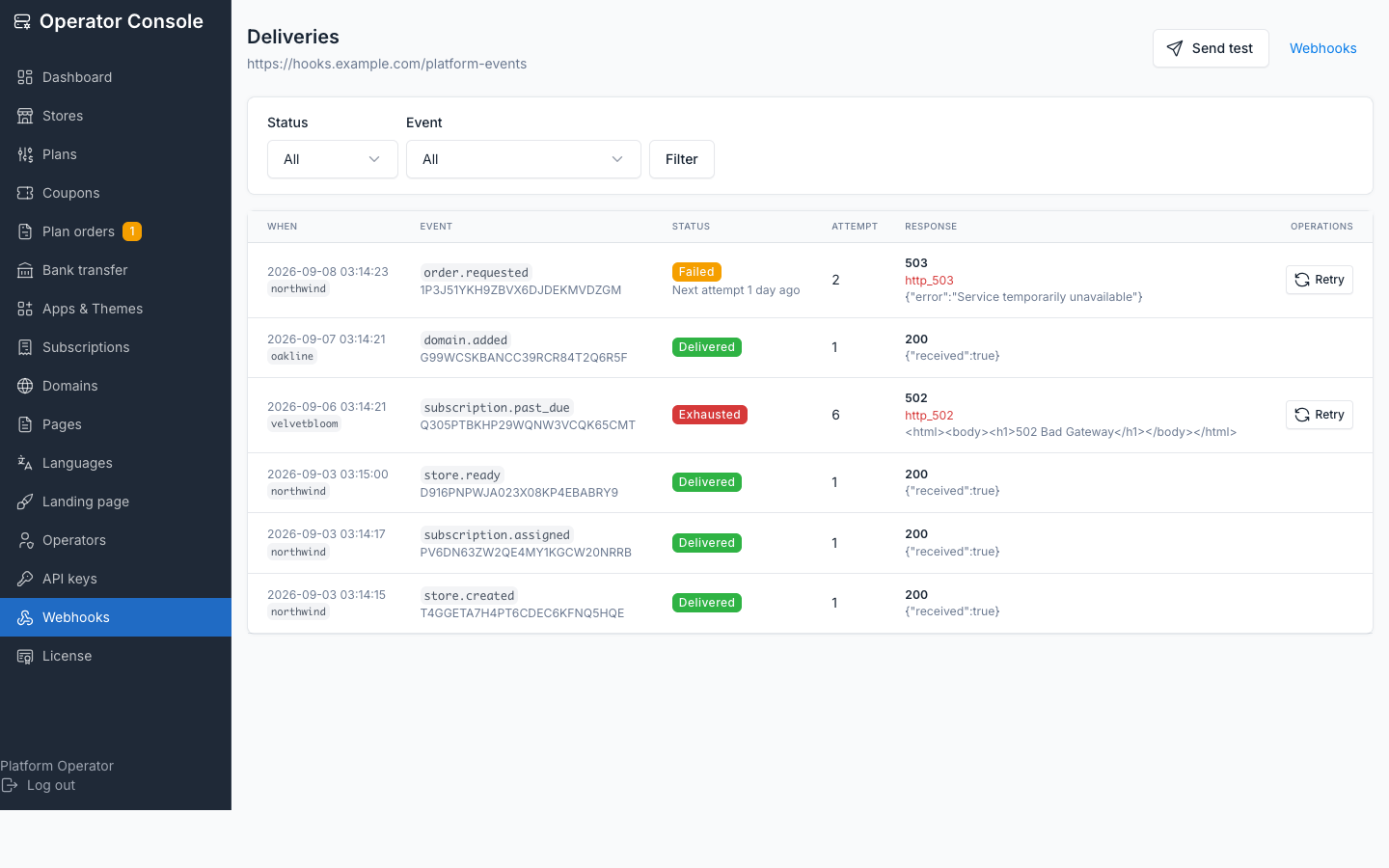
status | Meaning |
|---|---|
pending | Never attempted yet, a retry is scheduled, or an attempt is in flight |
delivered | A 2xx was received |
failed | The last attempt failed; next_attempt_at holds the next retry |
exhausted | Every scheduled retry failed, or the endpoint was not receiving when the attempt came due (error: endpoint_disabled); only a manual retry can revive it |
error is http_<status> for a rejected POST, endpoint_disabled when the endpoint was not receiving, unsafe_host when the hostname resolved to a private / reserved address at send time (no request was made), or the exception class and message for a timeout / DNS / TLS failure. response_excerpt is capped at the first ~1 KB of the body; the receiver's body is never read beyond that cap.
Rows in a terminal state (delivered, exhausted) are pruned by tenancy:webhooks-deliver once older than TENANCY_WEBHOOKS_RETENTION_DAYS (default 30; 0 keeps them forever) — this history is a window, not an archive, export it if you need it longer.
An endpoint_disabled row made no request, so it hands its attempt number back: a disabled window costs no retry budget.
Retrying by hand
Console: Retry on the delivery row. API: POST /api/platform/v1/webhooks/deliveries/{id}/retry. Both attempt inline and answer with the outcome.
An attempt reserves the row by bumping attempt, flipping status to pending and leasing next_attempt_at into the near future, so a retry while an attempt is in flight answers 409 delivery_not_retryable rather than sending the event twice. Once the lease lapses (a worker killed mid-request) the row is retryable again — by hand and by the cron sweep.
Rotating a secret
Rotate secret on the endpoint, or:
curl -s -X POST https://platform.example.com/api/platform/v1/webhooks/4/rotate-secret \
-H "Authorization: Bearer $KEY"{"data": {"id": 4, "secret": "whsec_xxxxxxxxxxxxxxxxxxxxxxxxxxxxxxxxxxxxxxxx"}}The old secret stops validating immediately — there is no grace window — so update the receiver in the same maintenance window.
WARNING
APP_KEY rotation invalidates every webhook secret. Endpoint secrets are stored with Laravel's encrypted cast, so rotating APP_KEY makes them undecryptable and every delivery then fails with a decryption error. After any APP_KEY rotation, rotate the secret of every webhook endpoint and update the receivers. API keys are unaffected — they are sha256 hashes, not encrypted values.
Testing an endpoint
Send test on the endpoint fires a ping — it always contacts the endpoint, even one that is switched off or auto-disabled (that is how you check a repaired receiver before re-enabling it). The first attempt is made inline, so the row you land on already carries the receiver's answer. ping is not subscribable and has no store in data.
Tuning
| Setting | Default | Purpose |
|---|---|---|
TENANCY_WEBHOOK_TIMEOUT | 10 | Hard total timeout, in seconds, for one delivery request |
TENANCY_WEBHOOK_QUEUE | (default queue) | Queue for the first attempt of each delivery |
TENANCY_WEBHOOK_DISABLE_AFTER | 25 | Consecutive failures before an endpoint is switched off |
TENANCY_WEBHOOKS_RETENTION_DAYS | 30 | Days after which delivered / exhausted rows are pruned by the sweep; 0 keeps them forever |
TENANCY_WEBHOOKS_ALLOW_PRIVATE_HOSTS | false | Allow endpoints that resolve to private / reserved addresses — local development only |
If a delivery keeps failing and you cannot see why, check Troubleshooting next.
See the control-plane API for the full endpoint and delivery reference, and Queue worker and cron for wiring up tenancy:webhooks-deliver.